What Makes VALORANT Champions Shanghai Group Stage Day 8 the Best Watch for Fans Chasing Playoff Drama
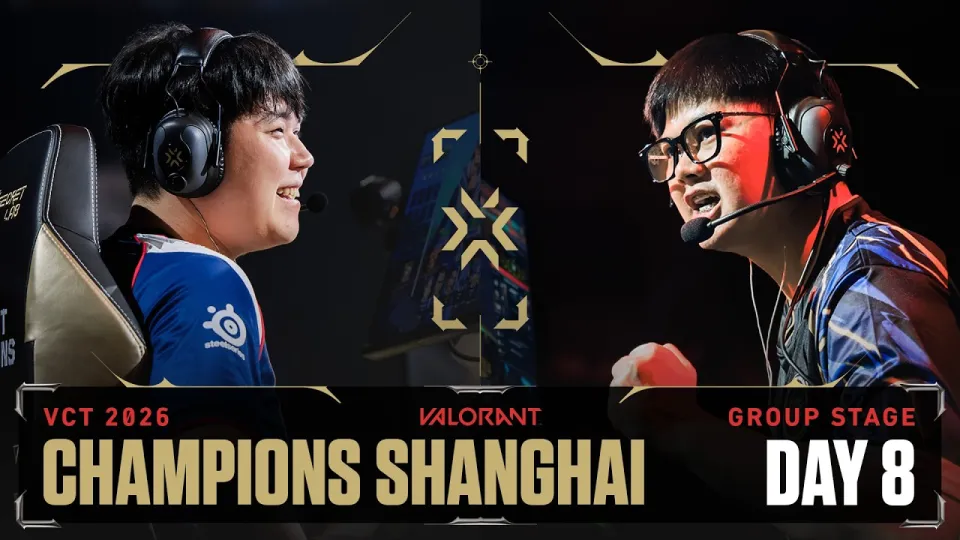
Video: VALORANT Champions Shanghai — Group Stage — Day 8
Want articles like this for your own video to promote it on YouTube and Google? Order them through the Telegram bot @sat_sit_bot. It writes articles around your video, embeds the video and publishes them on popular niche websites (no ads). Free trial — 50 articles.
· based on the channel VALORANT Champions Tour
The VALORANT Champions Shanghai Group Stage Day 8 broadcast is the best single VOD to watch if you want to understand why the 2026 world championship bracket broke the way it did, because it contains both the collapse of the home region and the clearest look at how the international field punishes small mistakes. It is a three-map T1 vs JD Gaming series wrapped around an earlier elimination match, and it captures the exact moment the Chinese representatives ran out of runway. For live updates, bracket context, and official announcements, follow the tournament's primary channel at VALORANT Esports on X.
What the Day 8 results actually decided in the VALORANT group stage
Day 8 was the last realistic window for CN teams to convert home-crowd energy into playoff seeding, and it closed without a single survivor. Sixteen teams entered Shanghai from four regions, and the group stage format rewards depth over one hot map: a team can win a map and still be eliminated if its map pool collapses on the third pick. That is precisely the pattern Day 8 exposed.
- JD Gaming lost a 6-11 lead on map one, a swing that would have put them up 2-0 in the series and changed the entire regional narrative.
- The remaining Chinese squads had already been squeezed out, leaving the host region with zero playoff representatives.
- The international seeds, by contrast, arrived with deeper map pools and cleaner mid-round calling, which is what decides close series at this level.
Why T1 vs JD Gaming became the defining series of the day
T1 vs JD Gaming was the marquee match because it was the last chance for the home region to stay alive, and it played out as a lesson in how leads evaporate against disciplined opponents. JD Gaming opened with structure and won early rounds through set plays, but once T1 stabilized on defense, the series turned into a grind where every retake and every post-plant decision mattered. The third map was not close: JD Gaming ran out of utility and confidence, and the scoreline reflected a team that had already spent its best ideas.
Two details stand out for anyone studying the VOD. First, the map-one comeback required T1 to win multiple low-buy rounds, which is the hardest thing to do in professional VALORANT. Second, the Crown getting silenced late in the match became the most replayed moment of the broadcast, because it symbolized a team losing control of the map's central resource. Neither detail shows up in a box score, which is why the full broadcast is worth more than a highlights reel.
The regional curse argument does not survive contact with the VOD
The popular explanation for the CN wipeout is a "regional curse" at home events, and the Day 8 footage does not support it. Home crowds help with morale, not with map pools. The teams that advanced did so because they had practiced the specific compositions and executes that the Shanghai patch rewarded, and the eliminated teams had not.
A better reading is structural. Chinese organizations received direct VCT slots, which raised expectations without guaranteeing the international scrim volume that EMEA, Pacific, and Americas teams accumulate year-round. When the bracket tightened, that gap showed up in the details: slower rotations, less efficient ultimate usage, and over-reliance on one or two star players to win duels. The commentary around "Kangkang and four bots" is harsh, but it points at a real problem, which is that a single carry cannot out-duel a coordinated five-man setup across three maps.
How to watch the Day 8 broadcast without spoilers
The Day 8 VOD is long, and the cleanest way to experience it is to treat it as three separate viewing sessions rather than one marathon. The broadcast opens with an earlier series before the headline match, so the structure matters if you want to preserve tension.
- Watch the opening series first, and stop before the analyst desk transitions to the next matchup.
- Skip the tech pause segment entirely if you are short on time; it interrupts momentum without adding competitive information.
- Save the T1 vs JD Gaming maps for a dedicated sitting, because the third map's outcome is obvious within a few rounds once you know the score.
- Keep the official social channels open for bracket updates rather than scrolling the VOD comments, which are full of untagged spoilers.
If you only have twenty minutes, watch the map-one comeback on the opening series and the final map of T1 vs JD Gaming. Those two segments carry most of the day's strategic value.
Common questions the Shanghai broadcast keeps raising
Viewers keep asking why a silenced Crown felt so satisfying, and the answer is that the Crown is a tempo object: whoever controls it dictates where fights happen. When it gets neutralized, the team that built its entire attack around it has to improvise, and improvisation at this level usually means lost rounds.
The second recurring question is about the hit registration complaints in the chat, where viewers counted bullets and concluded a shot should have been a headshot. Without frame-by-frame server data, those clips are not conclusive, and the broadcast's own replay tools are the only reliable reference. The third is about role assignments, particularly putting a traditionally supportive player on a duelist. That is a legitimate strategic choice when a team wants to overload one site, but it only works if the rest of the roster adjusts its utility timing, which is exactly what failed on the third map.
Useful links
- Official VALORANT Esports updates and bracket news: https://x.com/valorantesports
- Facebook: https://www.facebook.com/ValorantEsports/
- Instagram: https://www.instagram.com/valorantesports/
- TikTok: https://www.tiktok.com/@valorantesports
- Twitch live channel: https://www.twitch.tv/valorant
Final take on the Shanghai group stage
Day 8 is the most instructive broadcast of the Shanghai group stage because it shows a region losing not to bad luck but to a narrower map pool and thinner mid-round discipline. The T1 vs JD Gaming series, especially the blown 6-11 lead and the silenced Crown, is the clearest evidence that international VALORANT punishes teams who cannot adapt inside a single map. The host region's elimination also reframes what direct VCT slots are worth: access to the stage is not the same as readiness for it. If you want the full picture rather than a highlight clip, watch the Day 8 VOD, and keep VALORANT Esports on X open for the playoff bracket as it develops. This breakdown was built from the VALORANT Champions Tour channel's own broadcast, which remains the authoritative source for the event.
Key takeaways
- VALORANT Champions Shanghai runs September 24 to October 18 with 16 teams from Americas, CN, EMEA, and Pacific.
- Group Stage Day 8 featured T1 vs JD Gaming across three maps, plus an earlier series opened by a tech pause.
- All four Chinese representatives were eliminated in the group stage, including JD Gaming after a 6-11 lead slipped on map one.
- VCT partners for the season include AWS, Coinbase, Red Bull, HyperX, Mastercard, OnePlus, Secretlab, Globant, ENC, EWC, and Verizon.
- The full Day 8 broadcast is published on the VALORANT Champions Tour channel, with the official schedule and news at valORANTesports.com.
Source: VALORANT Champions Shanghai — Group Stage — Day 8 · Markdown version
Questions & answers
Why were all Chinese teams eliminated in the Shanghai group stage?
The elimination was structural rather than a home-crowd problem. CN squads entered with narrower map pools and less international scrim volume than EMEA, Pacific, and Americas teams, so when series went to a third map they ran out of prepared executes. JD Gaming's blown 6-11 lead on map one against T1 was the clearest example of that gap.
Why did viewers react so strongly to the Crown being silenced in the T1 vs JD Gaming match?
The Crown is a tempo objective: controlling it decides where fights happen and how sites get taken. When it gets neutralized, a team built around it has to improvise mid-round, and at this level improvisation usually costs rounds. That is why the moment became the most replayed clip of the broadcast.
Were the hit registration complaints in the chat justified?
Clips where viewers count bullets and expect a headshot are not conclusive without frame-by-frame server data. Broadcast replays and the official observer tools are the only reliable reference, and single-frame discrepancies are common in fast-paced duels. Treat chat verdicts as reaction, not evidence.
Is it worth watching the full Day 8 VOD instead of highlights?
Yes, because the day's value is in the decision-making, not the frags. The map-one comeback required multiple low-buy round wins, and the third-map collapse shows how utility timing falls apart under pressure. Highlights skip both, which are the parts that actually explain the bracket.